
12 Days in Peru: The Salkantay Trek to Machu Picchu
Peru · 12 days · Solo
12 Days in Peru: The Salkantay Trek to Machu Picchu
Altitude sickness, a 15,000 ft pass, the train tracks to Aguas Calientes and two days at Machu Picchu. My solo trip through the Andes, day by day.
The film
Watch the trip
Salkantay Trek to Machu Picchu: 80 km solo
The guide
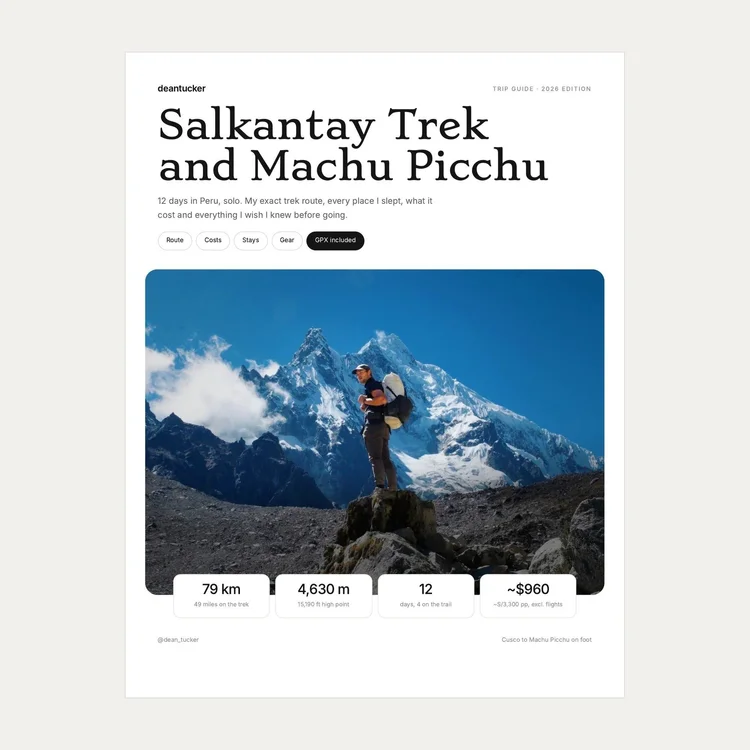
Do this trip yourself
Every stay, cost and day of the trip, the Salkantay route and what I would do differently.
12 Day Peru Travel Guide $19.99
The story
Day by day
Day 1: Cusco
After touching down in Cusco, I immediately grabbed a taxi from the airport to my hotel. The drive took about 15 minutes and I chatted to the taxi driver, rekindling my rusty Spanish vocabulary once again.
I arrived at my hotel and was checked in by a very friendly host named America. I asked if this was her real name and she confirmed. Surprised, I followed her up to my room, where she let me into my humble home for the next two days. Fortunately, this was exactly what I needed for day one. Since I was feeling sick as well as recovering from a badly sprained ankle, I knew a full day of rest would serve me well. Not to mention taking the necessary time to adjust to the high altitude. Cusco is one of the highest cities in the world, sitting at 11,000 ft above sea level. This meant even walking up the stairs to the front desk left me short of breath. And I was meant to hike over 50 miles and up to 15,000 ft in a few days.
After a solid nap, I decided it would serve me well to get out for a short walk to stretch my legs and get my lungs adjusted to the thin air. Fortunately, one of the best lookouts and main tourist attractions of Cusco was minutes away from my hotel. The hike up to Cristo Blanco was short but left me feeling the blood move through my muscles, begging for oxygen. It was a weird sensation, but a reminder that I am here, and I am alive! Reaching the viewpoint was spectacular, as I was able to get a glimpse of this entire valley for the first time. Once the heart of the Inca empire, this ancient landscape glittered in the setting sun.
On the way down, I stopped at a beautiful, quaint restaurant overlooking the same view and ordered a chicken sandwich for dinner. As I ate, I watched the sky turn to blue. With it, the air grew cold, as the temperature dropped dramatically with the setting sun. A hot shower later, and I was tucked away, set for a 12 hour sleep. Clearly my body needed it.
Day 2: Cusco
My first full day in Cusco was another spent adjusting to the altitude, this time more actively than the previous. I woke up around 8 am feeling well rested after a bumpy travel day the night before. I grabbed the included breakfast at my hotel (simple scrambled eggs, fruit and bread) and then walked out into the worn cobbled streets. Conveniently, there was an old Spanish aqueduct located mere steps away from my hotel, and so the obvious choice was made. Amongst a family photo shoot, I carefully found my footing in the shallow, still flowing source of fresh water and snapped some shots of my own. It's always amazing to see structures, of any kind, survive hundreds of years and still function as they were intended.
Following the streets downhill towards the main plaza, I passed a woman dressed in traditional dress. With her she had a baby alpaca. A sure bet to pull in any tourist (and a few soles)... including myself.
Not long after, I found myself ducking under the archways that led to the Plaza de Armas. Without a doubt, this is one of the most important and beautiful places in Cusco. The square sits in the historic city center, for both the Incas and the Spanish. The two focal points are the Cusco Cathedral and the Temple of La Compañía de Jesús, two structures that stand out because of their beautiful colonial architecture. Being a beautiful, warm and sunny day, the plaza was filled with life. Set against a backdrop of terracotta colored hills, there were locals commuting to work, tourists posing for pictures, and vans zooming around each corner.
Just a short walk away, the energy of the Mercado Central de San Pedro was pulling me in. Entering the market was like entering another city in itself. The sights, the sounds, the colors, the smells. It had it all. I was immediately called in every direction, solicited for souvenirs, fresh fruit, smoothies, chocolate, ponchos and more. I'm surprised no one was trying to sell alpacas right then and there! I'm sure it happened at some point before health and safety regulations were put into place.
Feeling bloated from the noise, I circled back towards the main plaza and through the streets back to the hotel, once again seeing a woman fully clothed in traditional attire with a bigger, but still petite, alpaca. Along the way I grabbed a quick sandwich for lunch at a small hole in the wall shop and sat on some rocks near my hotel to eat and take in the views. With my stomach full, it was back to bed. For the next few hours I rested. Even though today's adventure was relatively tame, the altitude was still clawing at my lungs.
Three hours later, I felt it was time to move once again. For some more altitude training, I decided to head up to Cristo Blanco again, this time less for the views and more for the acclimatization. That being said, the views were still stunning. On the way down, it made sense to grab an early dinner at the same restaurant as the night before. This time I opted for a simple hamburger with Andean style potato chips. With the light fading fast, I walked down the steep stairs back to the hotel and went to bed early in preparation for a 4 am wake up the next morning.
Day 3: Cusco to the Salkantay Trek
Despite the excitement to start my trek, I am never excited for the sound of an alarm before 7 am. Today, my alarm sounded at 4 am. Reluctantly, I rolled out of bed and fell into my clothes, laid out the night before. Fortunately I had the foresight to pack and prepare so that I didn't have to think about much in this zombie state of mind. Fully dressed and strapped up, I headed down the quiet, amber lit streets to meet my shuttle at 4:30. When I reached the location my driver had sent me, I was greeted by a fleet of about 15 identical shuttles. In a confusion of shouting guides and no service, I eventually managed to find the right one and we were off into the early hours of the morning. Despite the early start, Cusco was already buzzing with life. The main plaza seemed more akin to midday than 4:30 am. Since almost every tour you can do around Cusco is at least two hours away, the operators start bright (well, dark) and early.
The first hour or so of the ride was fine. I dozed off through most of it, but as we climbed higher into the mountains and up the winding roads, I took a turn for the worse. My body could sense the contorting pavement and it did not like what was happening. Fortunately I was sitting next to the window, and so despite near freezing temps, the fresh mountain air whizzing over my face was able to ease my pain... for now.
I settled back into the ride, this time trying as much as I could to focus on the horizon through the big, heavy black seats in front of me. We twisted and turned some more, and another onslaught of nausea, motion sickness and altitude sickness hit. Back out the window, like a dog enjoying the view. At this point I was seriously considering if this was a good idea and if I'd even be able to hike in this state, let alone 50 miles. I was a sick dog, but it worked, and I was able to hang on until we reached breakfast.
Getting out of the van, I was wobbly on my feet. Moments later we were shuffled into a small cafeteria along with five or more other tour groups. I grabbed a plate and dished up a light breakfast, but when I sat down, I struggled to get just about anything down. After maybe half a banana and a piece of bread, we were corralled back into the van. I was starting to feel a little better being on stable ground, but we still had one more stretch to go.
The next stretch was purely dirt roads, which you would think would be worse, but fortunately it meant slower driving. I hung on for half an hour longer, delighted to see the trailhead to the Salkantay Trek. Never in my life have I been so excited to leave a moving vehicle.
Starting on the trail, I felt the familiar sense of adrenaline, as well as the usual mix of excitement and anxiety. But there was something else pushing its way to the surface. It was the surge of the altitude once again, driving deep into my lungs and muscles. Luckily, it was a short stretch to the main trail, where it flattened out and followed an old aqueduct.
Reaching the top of the first incline, I turned to catch my first glimpse of Humantay. I don't think I've ever seen a mountain quite like it. So striking and stark against the clear blue sky. The ridgeline jumped out like another layer on the canvas of this picture perfect landscape. Following the aqueduct, walking had become much easier and I was able to regain my sense of balance and strength. It was now that I thought maybe my sickness wasn't due to the altitude but purely motion sickness. The fact that I felt fine now led me to believe the latter. I traversed the valley, with the face of Humantay growing larger with each step. Eventually I reached Soraypampa, a small mountain village filled with ecolodges, hostels and campsites housing every hiker in the area. I checked into my hostel and rested for a while, taking in the warm midday sun and the spectacular views of Humantay and the now visible Salkantay.
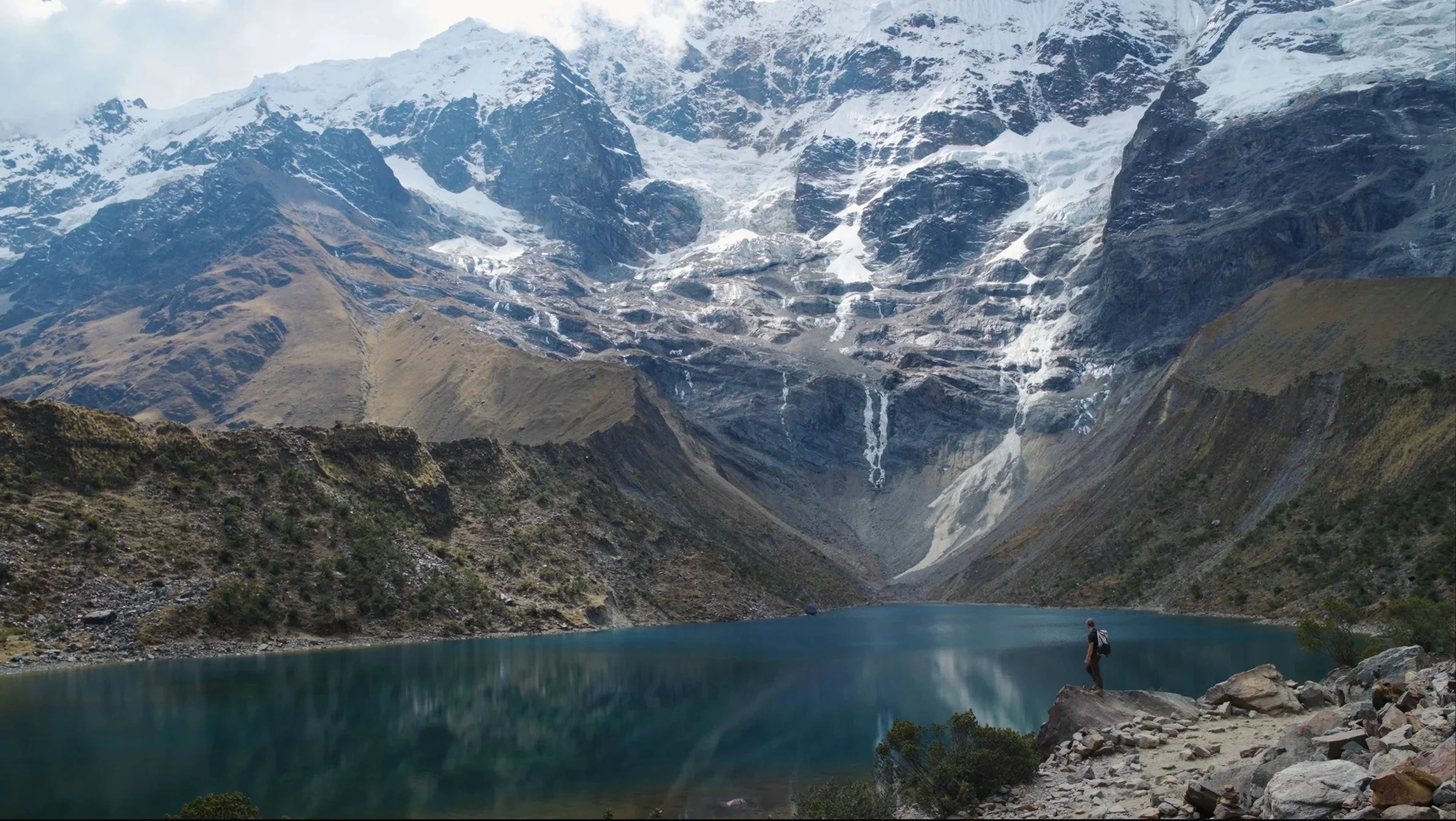
At 12 pm, I headed out once again, up towards Humantay Lake, a noble side quest for any Salkantay explorer. About a mile upstream from Soraypampa, the alpine lake of Humantay sits at 14,000 ft. This was now officially the highest I'd ever been on earth. Not a bad place to celebrate! The climb was slow and tedious, but I made sure to keep placing one foot in front of the other to keep a consistent pace.
Landing at the crest of the lake was like walking into a dream. It literally did not feel real, and even my camera lens wasn't wide enough to capture the full scene. I sat by the lake and mustered up the strength to eat some snacks. I was still struggling to get anything down, but I knew I needed the calories. Time felt endless at the lake, and before I knew it, an hour had passed and it was time to head back down.
The descent was much easier than the climb, for obvious reasons, and I made it back without a hassle, saying hello to a plethora of majestic horses along the way. Then a quick shower and another hour of rest before dinner in the common dining room: tea, popcorn, a chicken and rice dish, and a sweet, jelly-like dessert. While eating, I started chatting with two fellow solo trekkers. One was Cameron from Manchester, and the other (I can't remember her name) was a teacher from Austria on her summer break. We chatted about their travels in Peru and more about the trek. It was nice to know a few faces for the journey ahead. Then I was off to bed for another early wake up at 5:20 am. Exhausted, I passed out in seconds.
Day 4: Over the Salkantay Pass at 15,000 ft
I woke up to the pre-dawn rustling of my fellow hikers getting ready for the day at 5:10 am. With breakfast at 5:30, everyone was already up and about by 5:15. Having packed the night before and laid out my clothes, I stayed in bed until 5:20, then quickly got up to change and headed for the dining room. I sat across from Cameron again and we had tea, eggs and bread. We chatted for a bit, and then I left to go to the bathroom and get ready. When I returned, his pack, and he himself, were gone, with no goodbye.
This is always one of the strangest things to me when traveling. How you can meet people, make friends, and then in an instant they are gone like you never even met. I don't know if that's sad or just a small metaphor for all of life. Nothing is permanent, and just like these fleeting friendships, so is every moment. Hence why we need to appreciate each moment and be as present as we possibly can. Because just like my friends at the hostel, it will pass in the time of a trip to the bathroom.
Anyway, having laced up my shoes and taken in the glowing glaciers in the early morning light, I slung my pack over my shoulders and headed off on my trek to the new highest point I had ever been. Part of me was fearful of the altitude, given my body's reaction the day before and in Guatemala, but I was in good spirits and surrounded by hundreds of people if anything were to happen.
My journey began winding up the valley towards the behemoth that is Mt. Salkantay, standing at 20,000 ft, a further 5,000 ft above the level I would reach. Along the trail, I tried to keep up with the pack mules, but I was no match. They were like a Land Cruiser climbing up these hills, while I was riding a bicycle. Actually, no vehicle at all. I was walking, slower than I ever had before. Hiking at this altitude makes everything more difficult. The actual hike wasn't very difficult per se, but the altitude made it so. Each step uphill required twice the effort it normally took, and each breath required two to gather the same oxygen I was used to. Not to mention the sudden nosebleed and the crossing of frozen rivers.
Nevertheless, I pushed on, climbing higher and higher into the Andes and the gateway to the Amazon basin. Tantalizingly close, the summit of the Salkantay Pass was in sight, but it still required one last push. I looked down at my feet on the loose gravel and started counting to 100. One hundred steps and then I'll break. One hundred more and I'll be there. This is a technique I've used often when facing difficult climbs. Surprisingly, it allows me to focus on each step and make significant progress without stopping. Two hundred steps later, I had made it.
I was welcomed by a sight of 200 to 300 people. This felt more like a post run club hangout than a climb to 15,000 ft. I found a spot amongst the crowd, sat on the grass and then slowly laid my head down to rest. With Salkantay looming above, her presence felt somewhat comforting, despite my muscles still shouting for more oxygen. This heavenly space was just that.
After about half an hour taking in the views, I reluctantly packed up to move once again. Still having about 12 miles to go, I started my long descent. At least the rest of the day (and most of the trek) would be downhill, losing significant altitude along the way. This meant easier walking and fewer headaches. I was all for it, except for losing the stunning scenery you can only find at the top of the world. But I had my time, and losing altitude also meant new landscapes, flora, people and towns to experience.
The descent was a mix of steep rocky steps and loose gravel. Each step had to be taken with care, especially since I was still nursing a swollen, sprained ankle from playing soccer the week before. Slow and steady, I made my way down, letting each guided group of 15 to 30 people pass. Along the way, I passed a field of pink rocks and streams crossing the trail before reaching the first signs of trees once again, and my first glance of the elegant Santa Teresa River.
It was also around this time that I noticed my arms were now bright pink. Despite putting on sunscreen earlier in the day, I had forgotten how potent the sun is at high altitude, and now it made so much sense why people were still wearing long sleeves even though it was getting hotter the lower we went. Note to self: invest in a good thin shirt or a sun hoodie for the next adventure. Unable to bear the sun any longer, I pulled on my K-Way puffy jacket to protect my skin. A T-shirt drenched in sweat seemed like the better trade-off.
Around 3 pm, my weary legs were at their end, and fortunately so was my trek for the day. I arrived in Collpapampa and checked into my "glamp" spot for the night. Exhausted, I collapsed on the bed and remained there until dinner at 7 pm.
At dinner I met a fellow hiker named Frank. He was Peruvian and didn't speak English, yet I still got to know him and rocked a preschool level Spanish conversation. I learned which hike he was doing, how long he had been hiking for (five days), where he was from, and whether there were any nice beaches close to his home, since he lived near the coast. Having both finished our chicken and rice, we called it a day and went to sleep. A much needed rest after a long day out in the heavens.
Day 5: Down the River
In Collpapampa, I woke up to the sound of roosters with the break of the sun. Breakfast was at 7, and once again I was joined by my new friend Frank, although it seemed he had already been there some time and was just finishing up. For breakfast I had eggs, bread and tea. A simple meal, but one that filled me up and prepared my body for the long day ahead. Fortunately, this day would be all downhill, dropping another 3,000 ft or so.
Once I took my final bite, I paid my fees and said goodbye to my friends. Winding down an old dirt road, I walked until I reached a well trodden footbridge crossing the river into the forest on the other side, where I would meet my trail for the rest of the day. For the next 11 miles, the trail traced the outline of the surrounding cliff faces and wound its way through the valley, with the river raging down below. I passed magical waterfalls and precarious landslides, danced over rickety bridges and ducked under low hanging branches. Though the walk today was 99% downhill, don't be fooled by the work it still took to keep my legs from collapsing in on themselves. Each step required more strength to stop myself from falling down the steep slopes ahead. Nevertheless, it was still far easier than climbing at 15,000 ft, and only got easier the more I descended.
Around 2 pm I reached Via Monte Ecolodge in Lucmabamba. I walked up to a ghostly building, all boarded up, with no one in sight. This can't be right, I thought. This is definitely the place, so why is no one here? I walked around the property and found an old man sitting on a bench on the other side. I asked him if this was where check-in was, and he said yes. But upon further conversation, he had no idea what I was doing there and repeatedly kept saying he was the only one staying there. Frustrated, I walked over to the neighboring building to find someone else who could help me. Fortunately, there was someone there who spoke English, and I could explain the situation. Moments later, he called a woman who came over to greet me and check me in. Turns out her brother owned the place next door and she was just over there.
I spent the rest of the day resting, writing and editing my film. For dinner, I survived on trail mix and granola bars.
Day 6: The First Sight of the Lost City
After an early wake up and a quick breakfast at 6 am, my hike started off passing some friendly puppies and a hand painted sign for the local "Inca Starbucks," a precursor to the many coffee fields I'd be passing ahead. I also said hi to a perky rooster before starting up a steep ascent once again. Immediately, I felt my muscles tense and seize, like they were not yet ready for the day, but fortunately it was much easier walking at this lower altitude than on previous days. Passing through coffee fields, the red berries guided the way until the valley opened up to me once again, and I could see the Santa Teresa River in full strength and the peaks of Salkantay now well in the distance. I took a break at a rest stop lookout, and it was hard to believe I was way up there only two days ago.
When I continued on, I finally saw llamas for the first time on my trek, munching away at the leaves. As I crested the ridge, I saw layers of blue mountains like something straight out of a Disney movie, and with them, my first sight of the lost city: Machu Picchu. I spent some time taking it all in at a campsite littered with National Geographic branded tents. It really did feel like I was on the verge of jumping into one of their famed pages.
Reluctant to leave, I started my descent towards the river once again. Along the way I stopped to buy water and talked to an older man whose mouth was absolutely filled with coca leaves. I could barely hear him talk, but eventually I managed to make out what he was saying and give him the correct amount for the water. Under a shaded terrace I sat and mixed in my electrolyte packet, eager to replenish the salts and nutrients lost on my climb. Not long after, I reached the floor of this great valley, and the sky opened up as I walked out from under the dense trees.
Crossing my first suspension bridge of the day, I moved over the river just as the early explorers did centuries ago. I then passed the hydroelectric power station and a security checkpoint, and at last, I was officially within the bounds of Machu Picchu. Soon, I was walking along the famous train tracks that follow the contour of the snaking Urubamba River. For the next six miles I stuck to the tracks, mesmerized by the looming cliffs above and tropical birds I'd never heard before. It felt like I was in Zion National Park, but with far more trees and shades of green.
Walking the last few miles, my pack seemed to magically gain weight. The tracks felt like they went on forever, but with time came the trains and the tunnels. The royal blue PeruRail train passed like it was right out of an old storybook, with thick black smoke billowing into the jungle air. Approaching the train tunnels was slightly nerve-wracking. About 200 m long, narrow and dark, it would definitely not be a good fit if a train decided to pass through. But it seemed like a worthwhile risk to cut my distance to the finish line.
As I hurriedly passed through the last tunnel, the sound of an oncoming train radiated off the valley walls. A few more steps towards the light and the train pulled around the corner, ready to approach. I ran the final few meters out of the tunnel and ducked onto a dirt mound beside the tracks. When the train passed, Aguas Calientes appeared for the first time. Sweet relief. I walked into the mountain town covered in bites and battered. But I had made it! Or so I thought... I had one last push to my hotel. One hundred stairs straight up and I was there. The final stretch was brutal, and I arrived at the Eco hotel winded and out of breath. I immediately checked in and crashed.
I worked for a little bit in the afternoon and then decided to head out to the hot springs I had just learned about. Excitedly, I hurried out, quickly reminded that I wasn't able to move very fast. I hobbled over and arrived at the gates. With beautiful rock carvings and wooden railings following the river, it felt like I was in some Inca theme park. The jagged, steep cliffs would definitely make for some epic rollercoasters. With the anticipation mounting, I slipped into the crowded pools, ready to soak my legs and recover my aching muscles. Unfortunately, the water was not so much a hot spring as a warm spring. I spent about half an hour at the pools before grabbing some empanadas on the way back to the hotel and passing out shortly after. I was exhausted and needed some good rest for the big day tomorrow.
Day 7: Visiting Machu Picchu
After a solid sleep and a slow morning at the hotel, I headed for the bus station at 11:30. Weaving through the small town filled with restaurants, gift shops and tour companies, I arrived at the bus stop to join hundreds of people standing in line with their groups and guides. At first I was confused, as it seemed the infrastructure was not designed to accommodate this many people, and lines were forming haphazardly all over the place with no clear signage or direction. After standing in the wrong line for about 10 minutes, and then getting told off by another American tourist for cutting the line (even though I had no intention of doing so), I eventually found the right place and proceeded to wait in line for another half an hour or so. Finally, we got onto the bus and we were off!
With the bus packed to the brim, we switchbacked up the mountain, and I watched the mountains grow taller like an excited schoolboy. After about 20 minutes we reached the top, to more madness and a scramble of lines and people, confirming my theory that this site and its infrastructure were not built to accommodate 6,000 people a day. While waiting in line, I watched the buses doing 17 point turns to turn around, narrowly avoiding the surrounding people and other buses.
Fifteen minutes later I handed the official my ticket and passport and entered the gates. Following the cobbled stone walkway, I rounded the corner and there it was: one of the new seven wonders of the world in all its glory. My first impressions of the site were of wonder and disbelief. Then a flurry of thoughts rushed through my head. Who was the first person here? How did people possibly live here? Did they think they lived in heaven? I know I would. The mountains there are honestly the most surreal thing. It really didn't feel real. It felt like I was on some movie set and everything was almost a bit too perfect.
Climbing a series of wooden staircases, my first stop on Circuit 2 was the postcard viewpoint. This is the view that almost everyone in the world has seen, and most likely the only view anyone has ever seen of this phenomenal place. This only further excited me for the rest of the walk through the city. After many photos and videos, I made my way down the terraces and into the city itself.
I entered through the single stone doorway and was immediately struck by an intense sense of history. This was by far my favorite part of the experience. Personally, being able to walk amongst the structures allows me to feel fully immersed in the history of a place, rather than viewing it like a postcard. I slowly meandered my way through the pristine structures and onto the big, open communal field that sits at the center of the site. Even though it was so busy and touristy getting there, surprisingly it wasn't too bad once I was up there. This allowed me to take my time soaking up the views of the ancient architecture, the surrounding mountains and the lazy llamas. After a little over an hour walking through the site, it was time to head back down. Fortunately, I had another visit planned for tomorrow. A chance to experience this place a second time, and from another angle, which many don't even get the chance to do once.
Day 8: Hiking to the Summit of Machu Picchu Mountain
At 7 am I caught a bus to the bustling welcome area once again. Apparently the first bus departs at 5:30 am, and people start queuing at 4 am or earlier to be the first on site and witness sunrise over these magical hills. A short bus ride later, I was once again at the entrance. Today seemed far more relaxed than the day before, presumably because there were fewer people leaving the site at 7 am than at 12 pm. An element of excitement filled the air once more as I stood in line, this time more confident of how things worked and where to go. After 15 minutes of waiting, I checked in and started my ascent to the top of Machu Picchu Mountain.
With 2,139 ft (652 m) of elevation gain over only 2.3 miles (4 km), this is definitely not an easy hike going up. But having just done the entire Salkantay Trek with a pack, I felt like a fit llama climbing up that mountain. I charged up the hill, skipping every second step as I walked. It almost seemed easier that way, until I remembered I was still at 6,000 ft of altitude and needed a second to catch my breath. Cursing myself, I realized I had forgotten to bring water. Fortunately, the day was still cool, as the sun had not yet reached its peak.
After about an hour of constant steep stairs, steep drop-offs and a mop of sweaty hair, I made it to the top of this historic mountain. I believe I was the first of the day to the top, a special, almost spiritual moment being up there all alone. I was welcomed by incredible 360 degree views: the city down below, Huayna Picchu across the gap, layers of mountains to the north and glaciers to the south. Everywhere you looked was truly remarkable. I spent some time sitting and taking in all the views, still stunned that this landscape was real. Finally, I said my goodbyes and headed back down.
I had noticed the steep stairs on the way up, obviously, and the grand openings that let me see the valley down below. What I didn't account for was that I would have to retrace my steps down this narrow pathway, with the same grand openings and steep drop-offs into the valley below. Taking slow breaths and very intentional steps, I crept down the stairways, trying not to look at the views too hard. Eventually I landed on a very sophisticated, sideways-down method for maximum stability, twisting my body parallel to the steps and crisscrossing my feet so that each foot could fully plant on the step below it. It sounds like it wouldn't work, but somehow it did. In total it took me two hours to get up and down, and I felt proud of myself for smashing the recommended four hours.
Feeling a hint of sadness, but at the same time content and extremely grateful for my experiences up here, I bid farewell to the lost city one last time as I walked through to the exit. Then it was one last bus down, more empanadas and a final night in Aguas Calientes.
Day 9: The Train Back to Cusco
On my final day in Aguas Calientes, I woke up and immediately headed to the train station. I grabbed a quick cappuccino while I waited for the train and sat on a park bench, admiring the mountains lit up with morning light one last time. At 8:50 we climbed aboard the magical storybook train I had seen a few days earlier. I found my seat and we left the station at 9 am sharp. The PeruRail Expedition was headed out of Aguas Calientes and into the heart of the Sacred Valley. The train wove through the landscape like a snake, following the curves of the river beside it. All the while, I was imagining the perilous journey Hiram Bingham embarked on a hundred years ago, and the even greater journeys the ancient Incas made before that.
I love trains, and I wish the world used them more often, especially as a replacement for highways. There's something so relaxing about trains, and I took full advantage of it, almost passing out multiple times before another gorgeous view through the skylight windows kept me wanting to see more. Two hours later we arrived in Pachar, where we transferred to a bus for a further two and a half hours back to the mother city.
I hadn't eaten anything yet, so I grabbed lunch on the walk back to the hotel: grilled pork and sweet potato paninis at a cute hole in the wall called Jill's. I watched a family argue about something in another language, to the point where two members got up and stood outside arguing about something else. It was somewhat entertaining until I got my food and was put into a trance by how good it was.
After lunch, I checked into the hotel and edited some videos. Then I walked around town, popping in and out of gift shops, before settling in for dinner at a nice restaurant next to my hotel. It was a fancier place, and I sat next to a young couple clearly on an early date, as the young man did all the right courteous things you would expect. Good for them, I thought, as I sat there now missing my own date nights and a sense of normal life again. Once again, the food snapped me out of my inner monologue, and I was served my first ever grilled alpaca steak. From the first bite, it was delicious. That being said, if you hadn't told me it was alpaca, I probably wouldn't have known. I don't know if it was the way it was prepared, the texture, or our habit of assuming any red meat is probably beef, but I would've assumed it was just that. Either way, the meal was phenomenal and set me up for a very comfy sleep in my hotel right next door.
Day 10: Pallay Punchu
Another early wake up: 4 am today, ready to be picked up at 4:30. I walked down to the plaza in the early hours of the morning, and some people seemed like they were still stumbling home from the night before. I met my van, this time a lot more easily than the last, and climbed aboard. I picked a seat further back, hoping the additional headroom would quell any nausea like I'd experienced on my last van ride. Luckily the road today was much calmer and a relatively straight shot to our destination. Our driver hit the accelerator and, once again, the city was alive, as hundreds of tour buses departed the hub of Cusco for their various destinations hours beyond the surrounding mountains.
Today, we were headed south towards a mountain known as Pallay Punchu. In my brief bit of research, I had come across the well known Rainbow Mountain, but many of the reviews and photos showed it was just overrun with people at this point. I then came across a lesser known but just as impressive looking mountain called Pallay Punchu. With the promise of fewer people and yet still amazing landscapes, I was sold.
The first two hours of the drive were drenched in darkness, and I took full advantage of it, struggling to keep my eyes open, and slept for most of the way. Lucky this time, there was no motion or altitude sickness mishap, despite climbing in elevation once again to 15,000 ft. We stopped for breakfast at a small catering place that served a buffet of scrambled eggs, pancakes, fresh fruit and bread. Along with a cup of coffee, I stocked up. Another two hours in the van and we were at the entrance to the park. We crawled up a narrow dirt road, ignoring the steep drops down below, and finally made it to the parking lot.
I stepped out of the van and was immediately hit by the familiar alpine cold once again, although I resisted putting on a second jacket, knowing we'd be climbing in just a few minutes and it would come straight off. As the wind pierced my first layer, we listened to a short introduction from our guide about the area. It was all in Spanish, but I understood most of it, which I was proud of. I secretly hoped we wouldn't be sticking together the entire time, since I despise being herded like a sheep in big groups. Fortunately, he gave us a simple return time and unclipped the leash.
With my body well adapted to the altitude already, I pulled away from the pack fairly quickly. Noticing another big group at the first lookout, I decided to walk up to the end of the trail and work my way back. That way, I'd avoid the crowds on the slippery gravel surface and steep drop-offs, and get the clean shots of this unique landscape I so desired.
Fifteen minutes of hiking and I had reached the far end, now able to peer over the edge to the opposite face, lined with alternating bands of different rock and color. I now understood why this place was named the way it was. Pallay Punchu translates to "decorated poncho" or "woven poncho" in Quechua, and it genuinely looked like a giant colorful poncho rolling over the land. I spent some time wandering over each crest, taking in the views and marveling at all the different colors this landscape had to offer. From the macro to the micro, this unique palette painted everything it touched.
After three hours, it was time to return to the van, and with it, see the biggest herd of llamas I'd seen on the trip yet! With another stop at the same place for lunch, a friendly hello from more cute llamas, and four more hours of driving, we arrived back in Cusco at around 5 pm. Another full day of adventuring, and I was ready to hit the hay once again, calling it an early night.
Day 11: Work Day
On my penultimate day, the clouds rolled in and the heavens opened up. A wet and windy day lay ahead, which seems like a letdown, but it quite suited my state of being. A day where I didn't feel guilty sleeping in, taking it slow and catching up on work. After a slow start, I waded down to a small cafe called Van Gogh's Cafe, entirely inspired, as you can imagine, by Van Gogh and his incredible artwork. The walls and ceilings were covered with replicas of his famous Starry Night and Sunflowers. Big windows lined the edge of the room, and the soft light filtered onto my coffee and chocolate croissant.
After a bit of work, I walked further down the hill and around town a bit more, specifically to see the ancient Temple of the Sun, Qorikancha. Unfortunately, most of it was destroyed or altered during the Spanish conquest, and so only a small sliver of the original structure remains. That being said, it was still amazing to witness and imagine the Inca kings of the past visiting the site that was the centerpiece of the entire empire. The rest of the day was spent back at the hotel resting, since regaining altitude to 11,000 ft was starting to show its effects, and my body wasn't quite so happy to be back. My lack of appetite and energy meant another early night.
Day 12: Work and Leave
The final day, and my body was ready to leave. I woke up with a headache, a lack of appetite once again and shortness of breath. All the familiar, textbook signs of altitude sickness. Unfortunately my flight out was only at 6 pm, so it meant one more day of moving slowly. After checking out of my hotel and saying goodbye to the wonderfully friendly staff, I headed to one last cafe: the famous Three Monkeys, voted one of the 100 best coffee shops in the world. The coffee was indeed fantastic, and the entire experience felt more like a wine bar than a coffee shop.
Sufficiently caffeinated and fed, I wandered the streets and went gift shopping. I picked out some trinkets for loved ones back home and grabbed a cool llama print jersey for myself, perfect for the autumn weather looming back in the Northeast. Just like in Guatemala City, the airport was within walking distance of the city, so I decided to spend the final few hours of my trip wandering the streets and weaving my way back to the runway. At 6 pm I departed for Lima and caught my connecting flight back to JFK.
Looking Back
All in all, my trip to Peru was an experience I will never forget. It gave me my first taste of real altitude sickness, but with it, access to a wonderland of high altitude mountains I had only dreamed of and seen in pictures before. Not to mention the incredible journey through the valley to one of the most spectacular sights of the ancient world. Although my body was ready to go home by the end of the trip, this trek confirmed my love of adventure and exploration.
One of my favorite parts of the trip was imagining myself in a time well before my own, when the line between man and nature blurred and explorers ventured into a new frontier, crossing the boundaries of what was possible, physically, mentally and spiritually. Even though the heights of the Andes were not forgiving, Peru left me with eyes wide open. With so much more to offer, I will be back.
Gracias, Peru.